Local
Who decides usefulness?
fluff
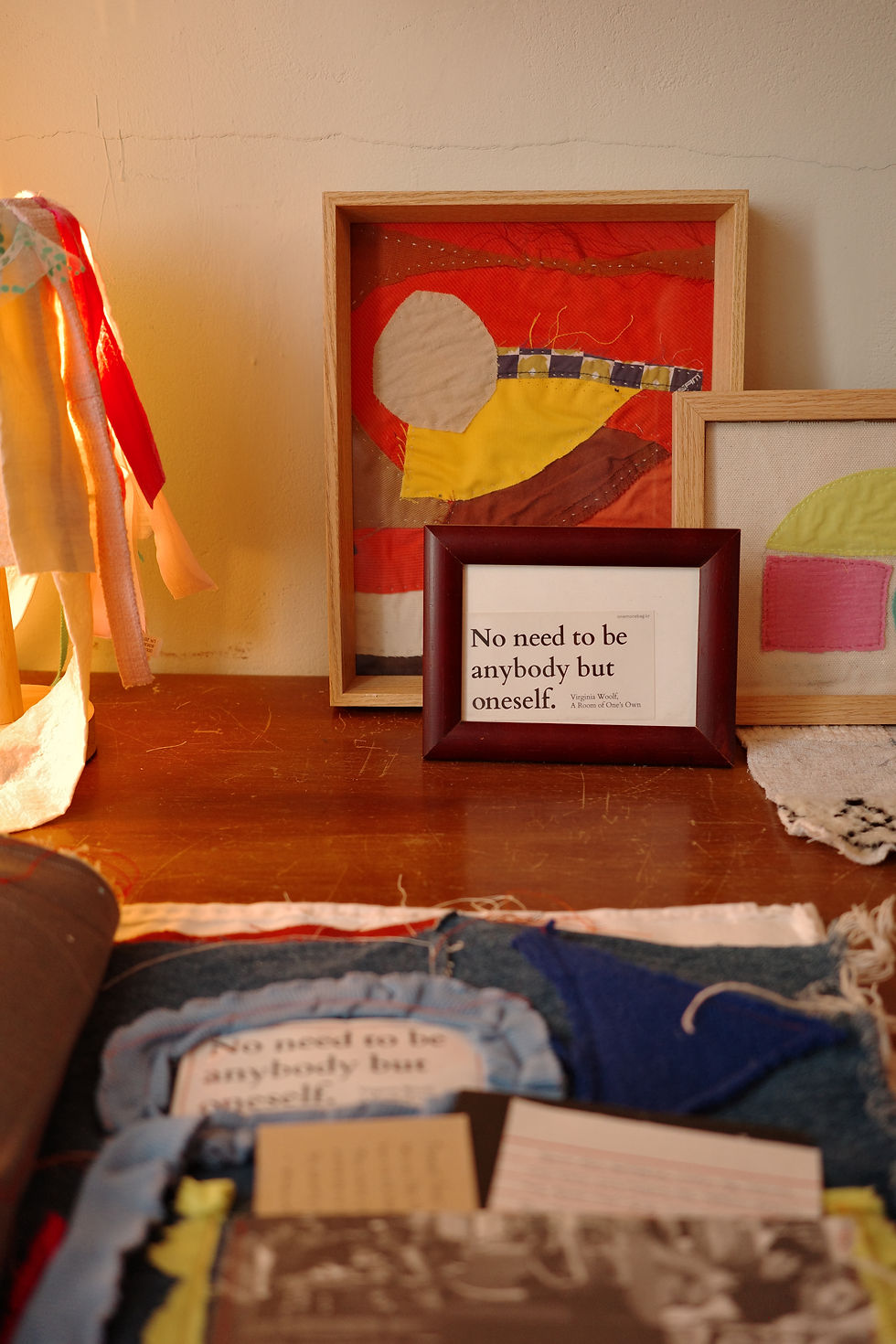
Scraps left over from making clothes, trouser hems cut off after repairs. Artist Lee Cha-hee gathers fabrics deemed to have served their purpose and spreads them out anew. These fragments, varying in shape and color, undergo spontaneous combinations to become bags, clothes, and small accessories. BOPOOL began with the idea of looking at existing things in a new light instead of buying new ones. In this exhibition, 'Edit Debt: Neo Local,' she continues these combinations using leftover fabric scraps from The Hyundai Seoul's alteration studio.
BOPOOL
This is the brand of artist Lee Cha-hee, who transforms discarded materials—such as unused clothes and fabric scraps—into new works. Instead of using new fabric, she creates bags, clothing, and accessories by combining pieces with different shapes, colors, and textures. She consistently conducts the 'Scrap Composition Workshop,' where participants personally compose and sew fabric scraps, and has expanded her activities to include exhibitions, workshops, and book clubs utilizing locally collected materials. She explores ways in which the time, traces, and distinct individualities remaining in each material harmonize by viewing what already exists in a new light.
Gathering back things that have fallen away from somewhere's standards
I think they wanted to declare the value of its existence under the name 'fluff'.
Q. BOPOOL transforms unused clothes and leftover fabrics into new objects and works. What inspired you to use these as materials for your work? I am also curious about the process of expanding the range of materials to include fabric scraps.
There was a time when my shoulder hurt, so I went to an online shopping mall needing a handbag. However, no matter how much I scrolled down, items kept appearing endlessly. I felt a desire to break free from the cycle of constantly producing too many new products. From then on, I changed my habit of "buying new items" and began purchasing second-hand goods or recombining existing items in my own way. Making a bag out of a skirt I hadn't worn for a long time was one such example. From that point on, "a way of looking at things that already exist in a new light" became the foundation of BOPOOL. I also collected leftover fabric scraps because they looked pretty and useful to me, and as I combined them, they turned into another piece of fabric. Feeling that I couldn't use everything by myself, I started making things with others, which led to the current BOPOOL workshop.

Q. I heard that you have experience working as an editorial designer. How has your experience handling paper and typography influenced your current approach to selecting and combining fabrics?
I actually feel that I work in a slightly different way than editorial design. Since editorial design deals with text and information, it is a systematic process that establishes a precise hierarchy to convey intent, whereas working with BOPOOL is improvisational. The unintended scraps all have different shapes, making it difficult to plan ahead. As someone who juggles both jobs, I find it interesting that I can switch between these different working styles.
Q. 'Flint' is a mark that forms from wearing and using clothes for a long time. I am curious about the reason you chose the brand name BOPOOL and the story you wanted to convey through it.
I noticed that clothes no longer worn are tattered, faded, and covered in lint. Seeing such discarded clothes reminds me of "surplus humans"—those deemed useless based on productivity standards. Perhaps this is because it is a long-standing concern of mine. However, when I look at tattered and faded clothes again, there is an inexplicable beauty to them. This is because narratives and traces possess a naturalness and a beauty marked by wear that cannot be found in new things. It seems I wanted to gather back things that have fallen away from certain standards and declare their value of existence under the name "lint."
Q. Do you have criteria for selecting materials to work with from among countless clothes and fabric scraps? I am also curious about the process of combining different colors, patterns, sizes, and textures into a single piece.
Actually, I don't have any specific criteria for selecting materials. I collect any clothes that are at risk of being discarded after serving their purpose. However, if a piece is still perfectly wearable, I suggest wearing it a little longer or wear it myself. My priority is ensuring that it continues to be used where it is needed. While I make rough sketches when working, I don't decide in advance which scraps to use, so about 90% of the process is improvisational. Composing pieces based on the different shapes, textures, and colors of each scrap is BOPOOL's unique characteristic and a joy I don't want to lose.


Q. While working with fabrics from various regions, have you ever had experiences where the place where the materials were discovered or the stories of the people who used them influenced your work?
I recently held an exhibition in Baedari Village in Dongincheon, where I gathered a large pile of discarded hanbok from the market. It was an area with many old hanbok shops, and I even received fabric scraps from a dressmaking salon that was about 50 years old. By composing the exhibition with the hanbok and fabric scraps I obtained from Baedari, I believe the work effectively revealed a sense of local identity. Meanwhile, I have also conducted a project where I created bags by collecting unworn clothes and the stories behind why they stopped being worn. One person sent me a pastel-toned knit sweater and blouse, asking me to make a bag that felt like a friend; I could picture the vibe of that person through their clothes. As I crafted the bag to match that vibe, the result was different from my previous work. It made me realize that even with the same materials, the uniqueness that emerges when combined with a person's story is bound to be different.




Q. What do you think is the most deeply reflected regionalism in BOPOOL's work?
I am more interested in the individuality of the people who constitute a region than in defining it as a single identity. I believe that diverse regional characteristics and collectivism can emerge when that individuality is preserved. I think BOPOOL can also be viewed as a project that looks into the uniqueness of individuals and collects fragments of clothing worn by the people living in each region.
Q. Since BOPOOL does not use new fabric, the size, shape, and quantity of materials vary with each project. How do these constraints affect the work process and results?
Since BOPOOL does not use new fabrics, we always work under constraints. However, because we rarely set the final outcome from the start, I don't think there are any "unexpected results." I tend to naturally accept the process of working with the given materials.

Q. For 'Edit Debt: Neo Local,' you encountered fabric scraps from The Hyundai Seoul's alteration room as a material for the first time. How did this differ from the fabrics you have worked with previously, and how did you utilize their characteristics in this work?
Since the fabric came from a tailor's shop, most of it was trouser hems. Perhaps due to the nature of pants, the colors were similar and generally subdued. It made me wonder, "Why do pants usually consist of such similar tones?" Another distinctive feature was that the scraps were mostly square, as they were leftovers from lengthening. It was actually one of the first times I had seen a collection of scraps in this specific shape. So, this time, I am making patchwork bags by joining these square pieces together. I hope that as visitors look at these small pieces they usually overlook, they will think, "My hem could be remade just like that, too!"
Q. Following old clothes and fabric scraps from traditional markets, you have now turned leftover fabric from tailor shops into materials for your work. What do you hope to continue pursuing through BOPOOL's work in the future?
I have always been deeply interested in ways in which individual uniqueness is preserved while harmoniously blending together. I intend to continue challenging myself to see how clothes from different individuals can come together to create beauty while maintaining their distinct characteristics.
Maker's Pick
Patchwork bag made from leftover fabric at The Hyundai Seoul alteration shop

For this 'Edit Debt: Neo Local,' two bags were first completed using fabric scraps from The Hyundai Seoul's tailoring studio. Since most of the scraps consisted of trouser hems left over after lengthening, they are characterized by repeating square shapes and subdued colors. BOPOOL finished them as patchwork bags by joining pieces of different sizes and textures together, highlighting the unique traces of each piece. Starting with these two pieces, the artist plans to continue working with fabric scraps from tailoring studios.
COMING SOON!
Upcoming September, lint
Meet them in person at!
September 17 - 30, 2026, The Hyundai Seoul POP-UP ICONIC B1
fin.
𝗜𝗻𝘁𝗲𝗿𝘃𝗶𝗲𝘄𝗲𝗲 Bopool
Seeum Kim
Herehear
Edeit Seulgi Lee
Who decides usefulness?
fluff
Local


_2x3_6.jpg)
