
Cheongju
Cheongju, where immortal craftsmanship blossoms
City of Crafts | Park Hyo-seong
Cheongju embraces and molds crafts, bringing them to bloom into flowers every two years.
Edit Danbee Bae
Write Hyosung Park
Illustration by Nuri Kim
A city that crafts
Crafts are once again drawing attention. In an era that prioritizes speed and efficiency, and in a world dominated by digital and virtual technologies including AI, craft is the direct language that proves existence through the traces of the hand. Cheongju embraces and shapes crafts, bringing them to bloom like flowers every two years. The name of that flower is the Cheongju Craft Biennale.
Cities are remembered and enjoyed through their images. If so, what image does Cheongju evoke? Some might think of apples, while others might recall 'Jikji' (Jikji Simche Yojeol), the world's oldest metal movable type book. To me, however, Cheongju is a city remembered for its 'crafts.' Whether it was my first visit in 2015 or my last in 2023, the reason was the Craft Biennale. It is the same now, as I am scheduled to visit Cheongju in September 2025. It is, once again, because the Cheongju Craft Biennale is taking place there.

Held every two years since its inception in 1999 under the theme "Hands of Harmony," the Cheongju Craft Biennale has been a pioneering endeavor that brought the genre of craft, often considered marginal, into the biennale as a platform for international contemporary art. It has established a venue where craft—once perceived as an art of the past—can be enjoyed as contemporary art, and has reinterpreted it by integrating it with design and architecture, shaping craft from an object of preservation into a genre of creation. Having spanned 13 editions, the Biennale has reflected the sensibilities of the times under different themes and curation for each session, making Cheongju the heart of Korean craft by encompassing everything from traditional crafts to modern objects and craft experiments fused with digital technology. Serving as an experimental ground that embraces diverse discourses on craft and elevates it to the dialogue table of contemporary art, the Cheongju Craft Biennale has continued its long journey by taking on the role of breaking down the boundaries between tradition and technology, and between industry and art.
The Cheongju Craft Biennale [features] craft genres that are close to the non-mainstream
It was a pioneering attempt that led to entry into the Biennale, a platform for international contemporary art.
Traces of Cheongju's Time and Labor Transform into a Craft Exhibition
The location is as special as its deep meaning and valuable significance. The Cultural Manufacturing Center in Naegok-dong, Cheongju, serves as the exhibition space; this site was formerly the Tobacco Manufacturing Plant. Established in 1946, immediately after liberation, it was a representative industrial facility that drove Cheongju's economy for over half a century, employing approximately 3,000 workers who produced over 10 billion cigarettes annually. The building, which operated until 2004 before closing and being left abandoned as a massive vacant space in the heart of the city, was reborn in 2007. Cheongju City decided to revitalize the site into a center of art and culture, transforming the interior into exhibition halls, creative spaces, performance venues, and shops while preserving only the framework of the existing building. Photographs and production tools used to trace the history of the Tobacco Manufacturing Plant are on display, and the sight of numerous female workers wearing distinctive hats at work immediately caught my eye. I was deeply moved by the explanation that a separate daycare center was provided at the tobacco factory for female workers responsible for producing and packaging cigarettes, and that they were given specific time three times a day to breastfeed their children. I was impressed by the fact that the legacy of modern industry was preserved through layers of memory and architecture rather than being demolished.

Formerly known as the "Old Cheongju Tobacco Factory" following spatial regeneration, this site was renamed the "Culture Manufacturing Plant" in 2019 to signify a factory that produces culture, and it has served as the main exhibition venue for the Cheongju Craft Biennale since 2011. The main building, spanning over 50,000 square meters, showcases a unique aesthetic where its massive scale and the rough traces of the factory harmonize exquisitely with elegant craft works, while the South Building is currently used as the Cheongju branch of the National Museum of Modern and Contemporary Art. Alain de Botton, who visited the site in 2015 as the artistic director for a special exhibition at the Biennale, remarked, "It was a rough space. I have high expectations for how an elegant and sophisticated exhibition can be presented in such a grand and tough space," and his exhibition, themed around happiness, garnered significant attention.
The main building of the Culture Manufacturing Center features a large area and elegant traces of a rough factory.
It showcases a unique aesthetic that harmonizes exquisitely with craftworks.
A rich exhibition capturing contemporary issues and global craft trends
The Cheongju Craft Biennale is a rare international biennale centered on craft. Accordingly, its exhibition composition is rich; the main exhibition interprets and presents the present and future of Korean and global craft, addressing contemporary challenges such as sustainability, the environment, and labor through the language of craft. It can be described as an exhibition that symbolically demonstrates the philosophy and direction of each edition. In 2023, under the theme "The Map of Objects," the event moved away from human-centered craft theory to treat non-human beings equally and reflected on the indiscriminate overexploitation and consumption of resources and materials. The theme for the 2025 Biennale is "Building the World." It contemplates the idea that all acts of "building"—based on the necessities of life such as making clothes, cooking meals, and building houses—are connected to craft and constitute the construction of our lives and the world. The main exhibition is typically organized into four sections; however, due to the sheer volume of artworks and the sometimes profound meanings they hold, it can be difficult to maintain focus. It is no easy task to grasp the entire narrative in a single viewing. It is sufficient to understand just one or two sections that resonate with you. The Invited Country Exhibition showcases the country's history, nature, and lifestyle through its crafts, offering an opportunity to experience the diverse spectrum of global crafts. Thailand, selected as the Guest of Honor for 2025, is garnering even more anticipation as the first invited country from Asia.


A cradle that produces national representatives of Korean crafts
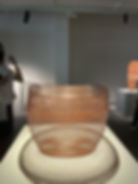
The highlight of the Cheongju Craft Biennale is the International Craft Competition. As an open stage for craftspeople from around the world, it has no boundaries of genre or restrictions on materials or media. It respects everything from modern experimentation to traditional techniques, discovering works that offer fresh interpretations of the social value of craft. At some point, I began to scrutinize the International Craft Competition closely, driven by an interest in the creators. Since craft is the product of a sincere aesthetic practiced by hand, I make sure to check the names of the works and artists without missing a single one, with a desire to support the makers. In doing so, I come across the national representatives who will lead the future of Korean craft; a prime example is "Horsehair - Comb Pattern" by artist Jung Da-hye, who won the Grand Prize in 2021. A native of Jeju, the artist presented a work inspired by prehistoric comb-pattern pottery while exploring the modern application of horsehair, the material used to make traditional hats. Seeing in person the meticulous care put into knotting each strand and stacking them layer by layer naturally evokes awe and wonder. Later, in the spring of 2022, I encountered her work at the Korean Craft Exhibition held in Milan, and witnessed firsthand the moving moment when she became the winner of the Loewe Foundation Craft Prize that same year. During a trip to Tokyo in April 2025, I also came across Jung Da-hye’s new horsehair lamp shining alongside craft works from around the world at Loewe’s *Crafted World* exhibition in Harajuku. Artist Jung Da-hye, who continues to hold overseas exhibitions in London and Spain, mentioned in an interview at the time that winning the Grand Prize at the International Craft Competition was a "reliable source of support," and she conveyed that she is still able to move forward thanks to that encouragement.
Global luxury brand Loewe has gained worldwide recognition for establishing and awarding a craft prize since 2016 to celebrate the excellence and artistic value of contemporary craft and to foster innovation. Since 2017, Korean craft artists have consistently been named among the 30 finalists selected each year. Notably, in 2022, the year artist Jung Da-hye won, a total of seven Korean artists were selected, five of whom had a connection to the Cheongju Craft Biennale. With the 2025 competition reportedly attracting applications from artists of 71 countries—the highest number of participating nations in history—and an increased number of submitted works, the search for future masters of craft is set to become even more exciting.
Illustration | The theme of the 2025 Cheongju Craft Biennale, 'Creating the World,' was depicted in the style of Chochungdo. Based on the connection between humans, objects (crafts), and nature, insects, fruits, and flowers that can be seen in September, when the Cheongju Craft Biennale begins, symbolize nature, while crafts made by human hands are expressed through blue and white porcelain.
External contributions to the Editorial Department are intended to provide a multifaceted perspective on local culture and industry and may differ from the views of the Editorial Department.

Park Hyo-sung
After working as a journalist and producing magazines for a long time, I encountered crafts and fell in love with them. I write columns on crafts, such as the series 'Park Hyo-sung’s Desiring Crafts' in The Hankyoreh, and plan exhibitions. I hope and desire that our crafts be used closely and cultivated into a beautiful part of everyday life.
Cheongju, where immortal craftsmanship blossoms
City of crafts
Cheongju
Edit Danbee Bae
Write Hyosung Park
Illustration by Nuri Kim


