Daegu
Daegu, New York, and Ordinary People
TK is the New Black (1)|Geunjun Lim
The new protagonists must emerge from among ordinary people who understand that precious soil.
Edit Mijin Yoo
Illustration Tatsuro Kiuchi
Im Geun-jun (Lee Jung-woo), a Seoul-born critic who has long observed Korean contemporary art, suffers from Borderline Asperger's Syndrome, and is an openly bisexual, surveys the past and present of art in Daegu and Gyeongbuk from a perspective beyond boundaries. Premised on a special affection for the art of Daegu and Gyeongbuk, he does so objectively yet with bias.
Park Seo-bo, Chung Sang-hwa, Lee Kang-so… and
Among active contemporary artists from Daegu and Gyeongbuk, monochrome painters belonging to the post-war youth generation, such as Park Seo-bo and Chung Sang-hwa, are the most well-known. The fame of experimental artists of a younger age group, such as Kim Ku-rim and Lee Kang-so, rivals theirs. Hwang Hyun-wook, a member of the post-liberation generation, contributed to the development of Korean contemporary art by founding the Daegu Contemporary Art Festival in 1974 and opening the In-Gong Gallery in 1988, while Kim Souja, belonging to the first baby boom generation, stands as a representative figure of Korean contemporary art. With such a plethora of prominent figures, it is difficult to even be mentioned unless one has reached a certain level of mastery.
However, these dazzling aspects are largely confined to the transitional period between the industrial and post-industrial eras. Today, facing a regional economic crisis, the future of the contemporary art scene in Daegu and Gyeongbuk depends on the task of finding a new point of opposition between the Seoul metropolitan area and the TK region, as well as balancing the precarious imbalance. This is likely true for all fields, including politics, economics, culture, and art.
The new protagonists are in Gangnam, Seoul or Williamsburg, New York
Not a third-generation member of the privileged class living in luxury
It must come from among ordinary people who understand the industrialized middle class unique to the Yeongnam region and its precious foundation.
From the perspective of young people, the fact that a few artists from the TK region succeed in Seoul and become famous in New York no longer holds significant meaning. The leading figures to spearhead a new regionalist art movement intertwined with the history, culture, and economy of Daegu and Gyeongbuk must emerge not from the privileged third-generation heirs living in luxury in Seoul's Gangnam or New York's Williamsburg, but from among ordinary people who understand the industrialized middle class unique to the Yeongnam region and its precious foundation. If we intend to envision such an alternative future, I believe we must re-evaluate the historical roots of contemporary TK art.
What created Daegu art, the act of crossing boundaries
Although TK is often perceived as a sanctuary of the right wing, if we examine the dynamics between the watercolor movement of the right wing's Seo Dong-jin and the national modernism movement of the left wing's Lee Yeo-seong and Kim Yong-jun in the early 20th century, as well as the subsequent generations of Lee In-seong, Lee Gwae-dae, and Yu Yeong-guk who drew nourishment from them, we can confirm traces of left-right cooperation and exchange.
Seo Dong-jin, who entered politics after being elected to the National Assembly in 1954, was not a figure who achieved great success as a painter. However, he made a significant contribution to the development of modern art in the Daegu and Gyeongbuk regions through watercolor education and the movement. The watercolor movement was launched based on the judgment that watercolor was more suitable than unfamiliar oil painting when seeking to embrace Western European modern art in East Asia, a region with a brush-painting culture. Its representative was Ishii Hakutei, and the Daegu Watercolor Society led by Seo Dong-jin referenced the Japan Watercolor Society established by him. Seo Dong-jin's disciple, Lee In-seong, participated in the 19th Japan Watercolor Society Exhibition in 1932 while studying in Japan; it was through this experience that he finally reached a stage where he understood and embodied the artistic concerns of Cézanne, Bonnard, and Gauguin.
Lee Yeo-seong, who walked a tragic path as a politician aligned with Yeo Un-hyeong, was an artist who began her career as a landscape painter and sought to be reborn as a national history painter, as well as an art historian who published *An Outline of the History of Korean Art* (1955). She also exerted a decisive influence on her much younger brother, Lee Gwae-dae.
Seo Dong-jin and Kim Yong-jun founded the comprehensive arts group Yeonggwahoe together in Daegu in 1927,
Since I pursued art that severed ties with the old ways of the past and made a fresh start from zero,
This was also a scene of subtle collaboration between the left and right.
On the other hand, Kim Yong-jun was a figure who fell into ruin while pursuing socialist modernism based on national identity. He was also the protagonist who guided people to find the archetype of national modernism in the so-called moon jar by interacting with Kim Whanki, collecting and praising large white porcelain jars. However, in 1927, Seo Dong-jin and Kim Yong-jun together established the comprehensive art group Yeonggwahoe in Daegu, pursuing art that severed ties with the old ways of the past and made a fresh start from zero; this was also a scene of a mysterious collaboration between the left and the right.
In 1930, Kim Yong-jun organized the Baekman Yanghwahoe with Gil Jin-seop and others to pursue an Oriental modern art movement, where 'Baekman' was a symbolic expression meaning 'white barbarians,' that is, modernists such as Fauvism. However, Yoo Young-kuk, who was influenced by art teacher Sato Kunio, also went to Japan, met Gil Jin-seop, Kim Whanki, and Kim Byung-ki at the SPA Research Institute, and entered the oil painting department at Tokyo Bunka Gakuen; thus, he is also a case where he somehow benefited from the watercolor movement of the preceding generation and the discourse of national modernism.
What TK Art Left Us, Expectations and Teachings for the Next Generation
Artists from the Daegu and Gyeongbuk regions held a special position in the early stages of Korean modern art. By fostering talent through modern art education and seeking to expand the base of art, they sought to achieve for future generations what they could not accomplish in their own generation.
The culture of placing our hopes on and investing our passion in the youth who will lead the future is a cultural legacy of TK that we must preserve. What do you intend to offer to the future generations of TK? Will there be anyone in our time willing to offer a passionate heart?
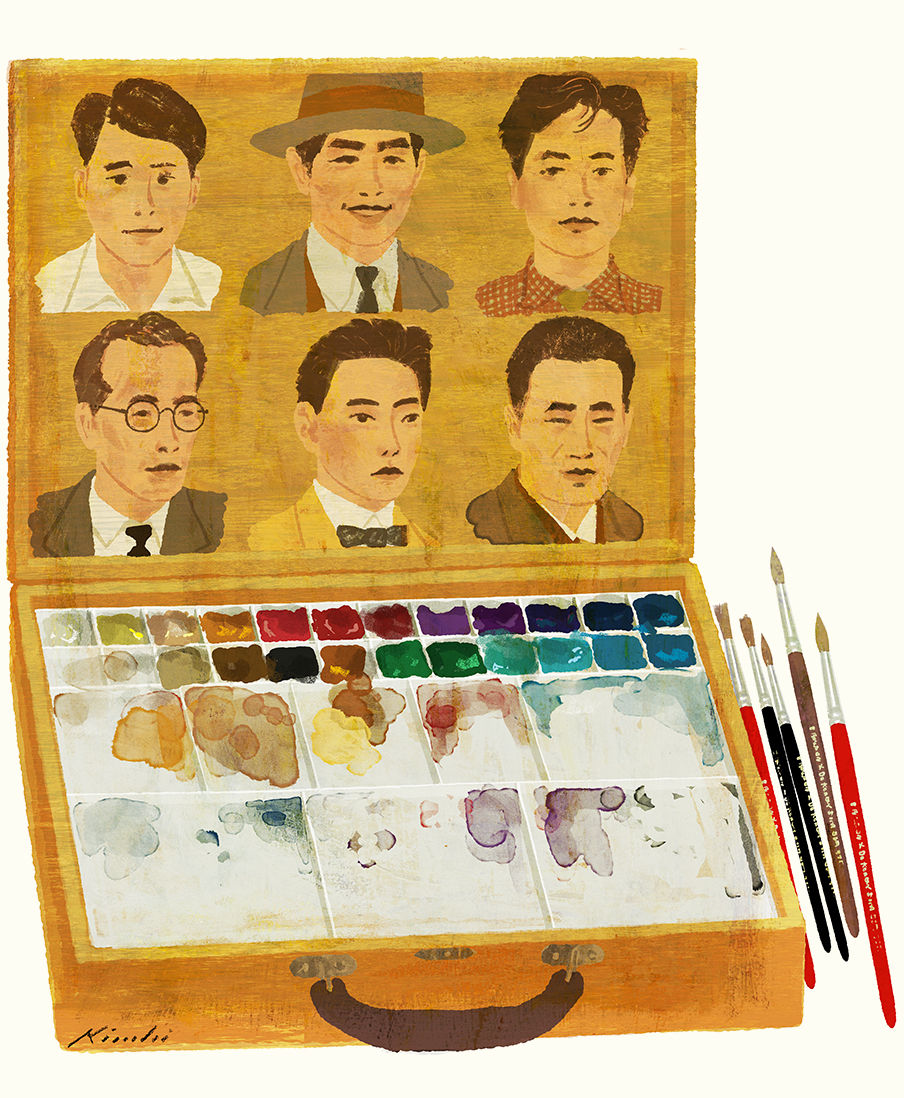
Illustration | Portraits of subsequent generations of artists from Daegu and Gyeongbuk are captured in Seo Dong-jin's *Portraits in a Palette*. From the top left, clockwise: Lee In-sung, Lee Kwe-dae, Yoo Young-kuk, Kim Jong-young, Seo Dong-jin, and Kim Young-jun.
**External contributions to the Editorial Department are intended to provide a multifaceted perspective on local culture and industry and may differ from the views of the Editorial Department.
Im Geun-jun
In today's world, where contemporary art is collapsing and deconstructing, he writes the art history of Korea and Asia based on persistent historical research. He studied design and art at Seoul National University and worked as a curator, editor-in-chief, and LGBTQ activist. Meanwhile, his Instagram account, @crazyseoul, serves as a chalet of the diverse human figures he observes daily. Posts dated October 28, 2022, when this profile was written, include images of the Christ the Redeemer statue, hypertrophic idols, a meme of Xi Jinping resembling Winnie the Pooh, and the obituary of Pierre Soulages.
Daegu, New York, and Ordinary People
TK is the New Black (1)
Daegu
Edit Mijin Yoo
Illustration Tatsuro Kiuchi


