Cheongju
To the house of connection in Caille
Summer, The Trajectory of the Landscape | Park Sun-young
When I open the window that makes up one side of the house, the fresh scent of summer blows in.
Edit Danbee Bae
Write Sunyoung Park
Photograph Yeseul Jun
Illustration So Won(Neap)

Heading to Cheongju after a long time. This is my second visit to the National Museum of Modern and Contemporary Art, Cheongju, since its opening in 2018. Created by renovating a tobacco manufacturing plant that had been abandoned for over a decade, this venue features a storage-style exhibition space, making the viewing route very interesting. I hurried my trip to Cheongju upon hearing the news that the museum was holding a special collection exhibition titled *Watercolor: Painting Water* . I felt that these 97 watercolors might be the very essence of the National Museum of Modern and Contemporary Art's collection. Watercolor, where the mediums of paint and water create subtle seepage and blurring, suits the season of summer better because, unlike the dull and glossy feel of oil paint, it produces a cool and clean effect. In the exhibition hall on the fifth floor, quite a few visitors were facing the artworks with their own individual perspectives. Lee Jung-seop’s paintings, which expressed the nuances of watercolor paint with vigor and conciseness; Kim Jong-ha’s rhythmic colors and lines, exuding a surrealistic feel; and Kwak In-sik’s brushstrokes, which depicted delicate pastel-toned overlapping petals through the transparency of watercolor. Under the name of watercolor, color, narrative, and experimental abstraction were being varied in diverse ways.


I lingered for a long time in front of Lee In-sung’s *Cailleux * , which captivated my heart above all else . Encountering a painting I saw at the Ho-Am Art Museum over a decade ago and in Gwacheon a few years ago in a different place is a sincere experience that creates a continuous context with the artwork. Things I hadn't seen before become visible, and newly emerging emotions fill the void between the painting and myself. It is said that the address of the Oyama Trading Company, where Lee In-sung worked at the time, is inscribed on the back of this still life, painted in 1932, the year after he moved to Tokyo. *Cailleux* means calla lily, but the painting features not only calla lilies but also roses and rudbeckias. The drooping purple roses and red rudbeckias contrast with the rising white calla lilies. The dynamic and dense brushstrokes, combined with the horizontal and intermittent brushwork against the black background, harmonize with the vertical vase to evoke a sense of stability. When recalling the tragedy of his untimely death at the age of thirty-eight from a stray bullet fired by a police officer, 'Kaiyu' comes across as a radiant expression of a bygone era, imbued with the tender resolve and excitement of his early days studying in Japan. The rich blending created by the slow seepage and gentle overlapping of colors—the very essence of watercolor—makes the medium feel even more contemporary. Dozens of watercolors completed between 1930 and 1990 brought today's summer to life with a luminous brilliance.

I drove straight to Jincheon, North Chungcheong Province, for a little over an hour, and arrived at Root Square , situated on a spacious site in Naechon-ri. Root Square is a complex cultural space that proposes new agriculture-based cultural content, featuring a smart farm, a café and restaurant, and three accommodation buildings. I decided to spend a day at Root Square with the hope that experiencing an ideal future agricultural environment might help solidify my vague plans to escape the city, even if only a little .

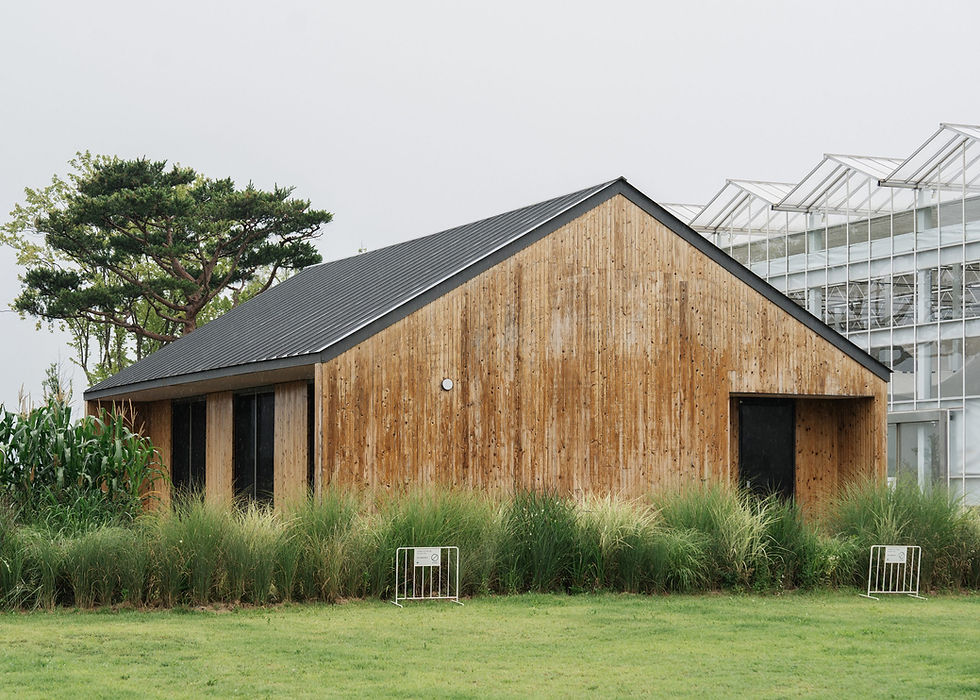
After checking in at the Welcome Center in Building A, the face of Loops Square, I went down to the first floor, passed through the Stem Garden—an indoor garden filled with the scent of nature—and stepped outside into the expansive greenery. Three houses—the "House of Communion," the "Small House," and the "Beneficial House"—stood side by side on flat land harmonizing with the surrounding rice fields. The place I would be staying was the " House of Communion ," designed by Japanese designer Kenya Hara . Built for the 2022 exhibition *HOUSE VISION*, this house features a simple rectangular structure topped with a triangular gable roof and constructed using solid wood panels. Upon opening the door, I found the bedroom, living room, kitchen, and bathroom coexisting in a single space without any separation by rooms or walls. The wooden furniture showcased by MUJI’s MUJI House project appears simple at first glance, but it takes the form of innovative four-sided furniture where the bed can be used as a table and bench, and a small table is attached behind the sofa. It is a flat house that fully embodies Kenya Hara's philosophy of pursuing the minimum in the form of his lifestyle.


As I opened the window forming one side of the house, the fresh scent of summer wafted in. Corn, taro, and bracken were growing in the garden, which was laid out with a wide wooden deck. This fairly spacious garden measures 35 pyeong (115㎡), the same size as the house itself. It was an idea for the "house that lives in harmony with the garden," which Kenya Hara considers ideal. A life where one picks plants grown by oneself and brings them directly to one's table . Furthermore, to connect the inside and outside, all level differences were eliminated, so when the windows were thrown wide open, the garden and the house became one. Taking the opportunity, I pushed the wheeled dining table onto the deck and enjoyed colorful summer fruits while basking in the sunlight. Standing at the end of the deck, I could faintly see a small house nestled across the bushes. I became slightly curious about what this minimal house for habitation contained and what it had emptied out. As the rain intensified, I went inside. Books such as *Thinking About Crafts*, *Night is the Teacher*, and *The Thoughts of Le Corbusier* were shelved on the shelf next to the bed. Since they all contained sentences about the forms of life and thoughts on life, I sat on the chair by the bed and haphazardly skimmed through several books. Books are particularly easy to read in places of travel away from home, because the recollection in unfamiliar spaces further heightens the tension of contemplation.

A day at Loops Square, a complex of future agriculture, is richer than any other stay. As soon as you open the door, a variety of programs await. At Stem Garden, which has become a landmark of Loops Square, I listen to the gentle flow of the stream and the stones where green moss rests softly. I pair freshly baked salt bread and black sesame gateau with a refreshing latte. Although it is filled with quite a few visitors, the interior, transformed into nature, feels as though moist air and empty space are floating around rather than noise. Walking along the deck that crosses the garden, I encounter a wild landscape of Nandina, ferns, and mosses breathing green amidst driftwood and rocks. I wonder how magnificent the scenery must be in Stem Garden, where weddings and yoga events are occasionally held. I went up a floor to the Smart Farm Showroom, which resembles a glass greenhouse, to look at prototype plant cultivators, and then purchased a bag of vegetables and a few basil seedlings that were said to have been grown using aquaponics at the local Uncle Farm. After browsing a shop selling gardening items and having a light soba dinner, the sun was already setting. Returning to my room, I opened the window slightly, and the rhythmic sound of crickets drifted over to me. The stillness of the countryside, which is not entirely silent; will birds chirp and wake me up tomorrow morning when the crickets have disappeared? The scenery of summer encompasses not only what is seen but also what is heard.


Park Sun-young
Park Sun-young studied art theory at the Korea National University of Arts and has consistently written about art, design, architecture, and travel. She began her career as a columnist in 2008 while on a leave of absence as a graduate student living in Paris; she personally recruited and interviewed people she could only meet there, contributing articles to * Harper's BAZAAR Korea *. Since then, she has written for various media outlets, including * VOGUE KOREA * and *Noblesse * , featuring her unique deep perspective and elegant writing style. She also plans exhibitions and events within and outside the realm of culture and art, bringing people together in one place. As a personal lifestyle advisor, she conveys the sensations of the unfamiliar time and space of "travel" through detailed writing that feels like a delicate weaving.
To the house of connection in Caille
Summer, the Trajectory of the Landscape
Cheongju
Edit Danbee Bae
Write Sunyoung Park
Photograph Yeseul Jun
Illustration So Won(Neap)


