Cheongju
The Trajectory of Culture and Art Drawn in Cheongju
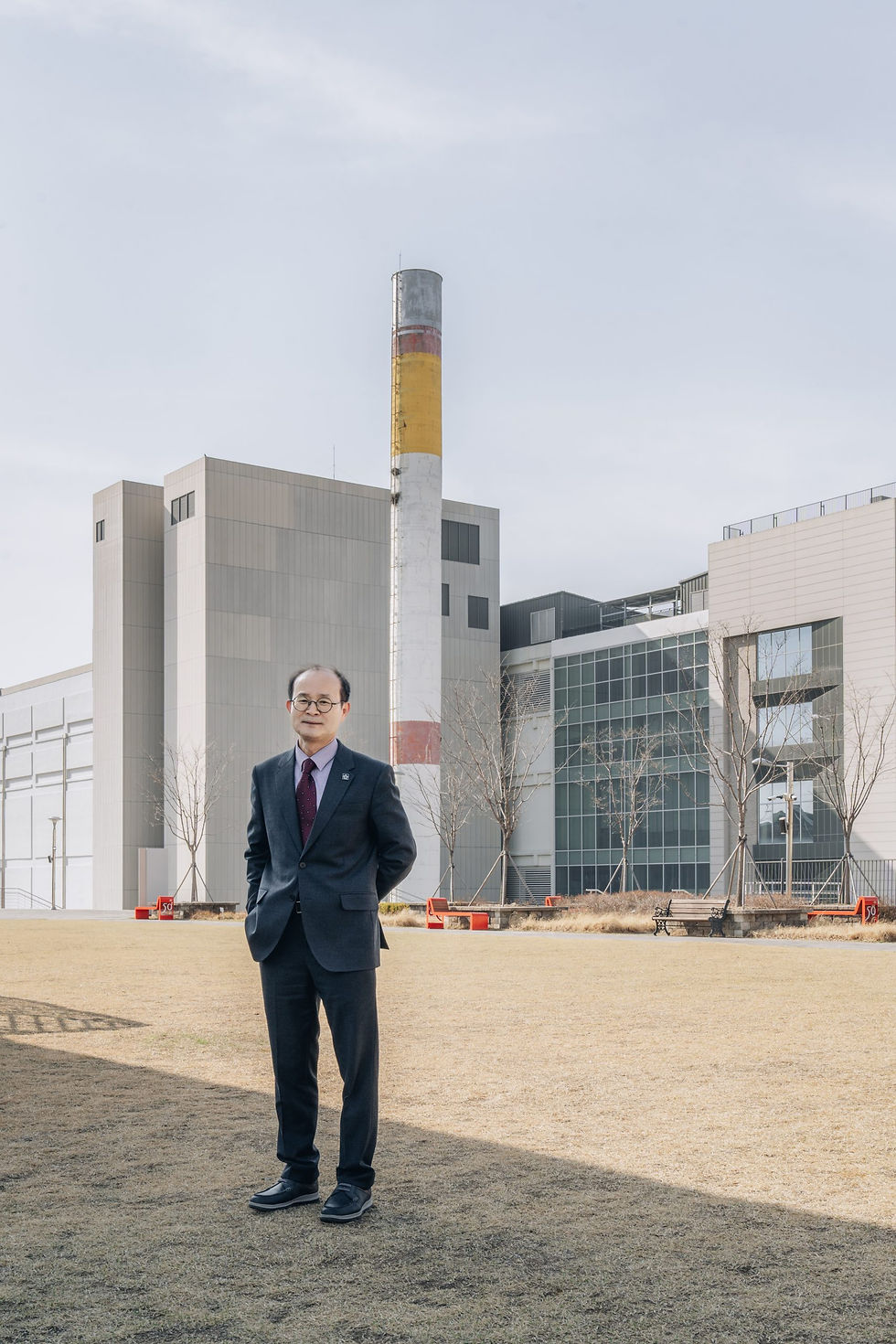
Dongbu Warehouse Byun Gwang-seop
The Trajectory of Culture and Art Drawn in Cheongju
Edit Danbee Bae
Write Jisun Chae
Photograph Yeseul Jun

You lead the Cheongju Cultural Industry Promotion Foundation (hereinafter the Foundation), which operates important spaces in Cheongju, including Dongbu Warehouse. I am curious to hear your story regarding Cheongju.
I was born and raised in Cheongju. My birthplace is Chojeong, where King Sejong the Great stayed for many years. That is why I have felt a cultural pride in Cheongju since I was young. Chojeong Mineral Water is one of the world's top three mineral waters, and Chojeong is the region where King Sejong the Great finalized the creation of Hangeul. Cheongju is truly the place where the Joseon Renaissance unfolded. With the hope that Cheongju’s unique, deep-rooted history and cultural identity will continue into the modern era, and that the city will become a place loved and appreciated not only within Korea but globally, I am carrying out various activities at the foundation.
Although the foundation operates numerous spaces and events, I don't think we can leave out the story of 'Dongbu Warehouse' when discussing the history of Cheongju.
In the 1960s and 1970s, workplaces in the countryside consisted entirely of rice paddies and fields, while cities were dominated by factory complexes. Cheongju also had about two large-scale factories. One was Daenong Textile, and the other was the Tobacco Manufacturing Plant. Since opening in 1946, the Tobacco Manufacturing Plant was utilized as a factory for producing cigarettes and a warehouse for storing them. However, from the late 1990s to the early 2000s, industrialization and mechanization eliminated the need for large factories. Systems became automated, and the smoking population had decreased compared to the past. As a state-run industrial facility, it was managed by the government, but after being transferred to the private sector, it was left abandoned for 10 years. It was in 2010 that the city of Cheongju purchased the abandoned factory.

And the following year, the International Craft Biennale was held in this space, right? I understand that is how the full-scale regeneration project began.
In 2011, the International Craft Biennale was held in an abandoned factory warehouse building, bringing global attention to both the Dongbu Warehouse space and Cheongju. Taking this as an opportunity, the central and local governments joined forces to launch an urban regeneration project. As part of this initiative, the Cheongju branch of the National Museum of Modern and Contemporary Art and the main building of the Culture Manufacturing Center were completed, followed by the successive creation of civic art spaces like Dongbu Warehouse, art education spaces, and high-tech cultural industry spaces.
Dongbu Warehouse has been transformed into an art factory. I am also curious about what you kept in mind most when revitalizing the space.
Daenong Textile was much larger in scale than Dongbu Warehouse. However, it has now completely vanished without a trace. One might think that it is merely the disappearance of a single building, but I believe that when a space vanishes, history and people disappear as well. Looking at examples from Europe, when a factory ceases to function, the space is neglected, and the city soon declines. Places where factories have been regenerated and specialized into cultural spaces are called Art Factories. In fact, when we decided to turn Dongbu Warehouse into an Art Factory, even the people of Cheongju were skeptical. Apartments could have been built on that site. But if we were to tear down an abandoned factory and build apartments simply because we didn't like the look of it, would that truly be "Cheongju-ness"? While contemplating what constitutes "Cheongju-ness," I thought that a tobacco factory could be one of its defining characteristics.
I'm curious why you think that.
In the past, the Cheongju area in North Chungcheong Province was a major tobacco production center. Tobacco farming was widespread here. Farmers would cultivate the crops, harvest them, and bring them here. They would produce and sell them, or export them. The majority of farmers in this region grew tobacco, while a large number of people from the city worked here as laborers. Up to 4,000 people were employed here at any given time. The area even housed carpentry workshops, restaurants, bathhouses, and barbershops. It was prosperous, as tobacco was exported to 17 countries overseas. However, I believed that if we simply removed it because it had reached the end of its life, the value of the economic labor they had cultivated here with their blood and sweat would vanish. I felt that this area needed to be specialized culturally, and since it was a space of industrial heritage, I believed we should create economic value through culture.


Perhaps that is why the stories contained within the space seem to be well preserved. It also appeared that they made an effort to ensure the space did not lose its original form.
We remodeled the space solely to meet structural requirements such as earthquake resistance and fire safety, leaving the wooden ceiling structure almost completely intact. We made a genuine effort to preserve the essence of the space. That is why visitors are captivated by the unspoiled value of this historical space; their inspiration and empathy serve as the driving force that enables us to continue our cultural activities. In essence, experiences continue at the Dongbu Warehouse, where stories and architecture from the past are preserved, as we interact with the citizens through diverse exhibitions, performances, education, hands-on activities, and markets.
In fact, a wide variety of programs are run differently depending on the space. How is the space at Dongbu Warehouse organized?
Dongbu Warehouse is divided into a lifestyle culture space, a performance practice venue for citizens, a lifestyle culture center, a children's art education space, a cafe, and a multi-purpose hall. Within the lifestyle culture space, there are a small theater, a woodworking shop, a food lab, and galleries. The lifestyle culture center is a space for lifestyle culture enthusiasts, and there are also two buildings prepared for children's art education.

There must be some programs that you are particularly attached to or would like to recommend.
We have been running the 'Dream Tree Orchestra' for elementary school students in the Cheongju area for 14 years. It is so popular that applications are very competitive. We also started operating the 'Dream Dance Troupe' program last year. It is a program designed to help local children cultivate their artistic talents and nurture their dreams. I consider this place to be a kind of open-air school that fosters children's dreams.
I understand that there are also many programs for the elderly.
We often refer to it as a second or third career in life. Dongbu Warehouse has a separate space set aside for seniors to engage in club activities. The important thing here isn't making money through these activities, but finding meaning in life. A truly diverse range of activities are offered, including busking, ensembles, bands, calligraphy, and knitting.

I understand that you have worked as a foundation employee for quite a long time. Given that you have helped shape the trajectory of culture and art in Cheongju, I imagine your vision for Dongbu Changgo as CEO must be extraordinary .
I believe I am the only CEO among the 140 cultural foundations nationwide who started out as an employee. I joined the foundation in 2002 and served in various positions, including Head of Planning, General Manager of the International Craft Biennale, and Head of the Cultural Industry Department. After leaving the organization, I was appointed CEO in 2020 through an open recruitment process. I believe that how I cultivate and lead Dongbu Warehouse going forward is of greater importance. This place should become a stage where more citizens and children can come to dream and where people from around the world can unite. To achieve this, we need to expand our reach. I plan to establish an international artists' village, such as a residency program, near Dongbu Warehouse, and to improve the creative studios as well. I hope that Cheongju will become a city where seeds are sown through culture, flowers bloom through art, and where culture and art serve as pathways to bear fruit in tourism. I intend to continue working diligently toward this goal.
Maker's Pick
3 Heritage Sites of Cheongju Introduced by Dongbu Warehouse


Seongangil
Seongangil is a street where you can experience the 1,500-year history of Cheongju. The Cheongju Cultural Industry Promotion Foundation has been operating cultural heritage programs for the past 10 years to revitalize the old downtown area, thereby solidifying Cheongju's historical significance.

Chojeong Royal Palace
It was built in the Chojeong Mineral Water area as a temporary palace where King Sejong the Great stayed for 121 days while traveling to treat illnesses such as eye disease. Subsequently, a healing village was established, and next year, a prenatal education land is scheduled to be built in conjunction with it.

Sangdansanseong Fortress
It is considered a representative historical heritage of Cheongju as a massive stone mountain fortress built in the valley style with a circumference exceeding 4 km, which has been preserved intact. The fortress walls, clearly visible even from a distance, have served as a guardian, acting as a fence for the people of Cheongju during times of crisis.





The Trajectory of Culture and Art Drawn in Cheongju
Byun Gwang-seop
Cheongju
Edit Danbee Bae
Write Jisun Chae
Photograph Yeseul Jun


