
Local
Chairs of unknown designer
So Dong-ho
Nameless chairs can be found in alleys, in front of shops, and in residential areas. These are chairs placed on the streets with unfamiliar shapes and colors, and unexpected uses. Industrial designer So Dong-ho has been observing and collecting them since 2017. 'Street Chairs of Seoul' is a record of discovering the daily life of Seoul and the designs created within it through chairs that are often overlooked.
Seoul street chairs
This is a project by furniture designer and curator So Dong-ho to document nameless chairs found throughout Seoul. By observing street chairs based on their form, color, material, function, and relationship with the surrounding environment, the project offers a glimpse into the lifestyles of people living in the city. The documentation began in earnest after he established a studio in Euljiro in 2015 and has continued since 2017 under the title "Street Chairs of Seoul." Hundreds of records have been presented in various formats, including posters and exhibitions, and were published as the book *Street Chairs of Seoul* in 2024.

The slightly unfriendly city that creates
I think it is absolutely necessary to have diverse appearances.
Q. You have been active as a furniture designer and planner, researching experimental chair designs. What prompted you, a designer who makes chairs yourself, to start documenting the nameless chairs you found on the streets?
Since I have a strong interest in chairs, I used to love the masterpieces of famous designers. I particularly enjoyed looking for details in chairs, but I think I started documenting them as I discovered other interesting elements even in nameless street chairs.
Q. 'Street Chairs of Seoul' is a project that has been documenting homemade chairs placed in Seoul's alleys, shops, and residential areas since 2017. When you first started documenting, which chairs caught your eye? I am also curious if your criteria for viewing chairs have changed as you have continued this work.
I have been working as an independent designer since 2010. I had been intermittently documenting street chairs, but I think I began documenting them more seriously after setting up a studio in Euljiro in 2015. At first, interesting elements such as unconventional forms, colors, materials, and usability caught my eye first. However, as I continued documenting, I realized that these chairs were not merely objects to be viewed lightly or for fun, given that they were used by people working on the streets.


Q. You are an artist as well as a planner who engages in archiving and design curation. How do creating things yourself and observing and collecting objects made by others influence each other?
I don't feel like they are different domains. After all, both involve persistently observing and unraveling things. While the work itself is inevitably subjective, I still strive to view it objectively. As both a creator and a planner, I think I try to look at things from a broader perspective.
Q. In 'Street Chairs of Seoul,' chairs tailored to the user's needs frequently appear, created by repairing ready-made items or adding materials found in the surroundings. What design possibilities did you discover in these chairs that differ from furniture made by professional designers?
This is known as vernacular design. While professional design begins with planning or planning, chairs found on the streets are created spontaneously out of necessity, giving them a more rustic character. Unnecessary parts are boldly removed, and essential elements are covered with readily available materials. Because they are transformed in ways rarely seen in conventional design, these distinctive features are actually highlighted even more. We draw inspiration from this and discover new possibilities.
Boldly cut out what is not needed,
I patch up the essential parts with materials I can get my hands on.
Q. As you travel through various districts of Seoul documenting chairs, it seems likely that their appearance varies depending on the neighborhood's environment or the occupation of the people working there. Please share any specific districts or chairs that particularly stand out in your memory.
Street chairs are more common than you might think. You can see them anywhere in Seoul, and they aren't much different in the provinces. However, the chairs used by street parking attendants have some unique features. Since they work outdoors for long hours, they are vulnerable to environmental conditions. Some attach umbrellas to the chairs to shield them from rain, snow, or sunlight, while others are made small and lightweight to prevent the risk of loss or to ensure they are moved frequently. They are thoroughly functional. If you happen to pass through the Jongno, Euljiro, or Dongdaemun areas, take a close look.


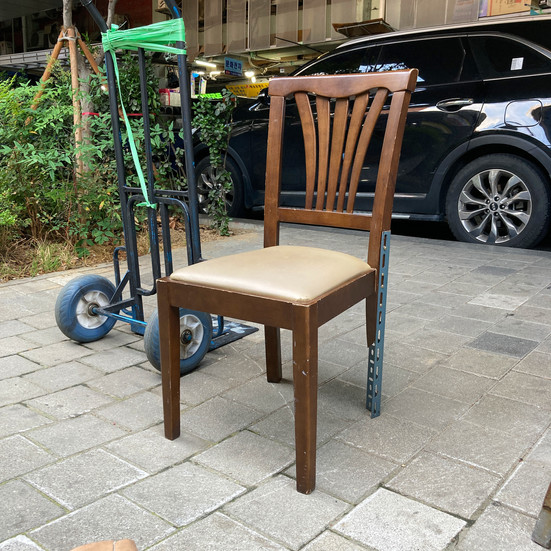
Q. Do you have any documentation principles when photographing chairs found on the street? I am also curious about how you examine a chair beyond just its form when capturing it in a photograph.
The most important element in this record is the chair that seems to be speaking to me. When documenting with photos, I do not touch the chair or tidy up the surroundings; instead, I quickly capture only the chair as the subject first. Sometimes the chair itself is special, but other times, it becomes special when it meets its surroundings.
Q. Gathering hundreds of chairs likely reveals commonalities that were not apparent when viewing individual photos. As records accumulate, have you newly discovered any patterns in how Seoulites use objects or characteristics of their lifestyles?
I feel a sense of unfamiliarity when I come across a massage chair or sofa on the street, or when an executive chair or gaming chair is left sitting alone on a main road. This feeling is even stronger when I see these chairs set against a street backdrop where they shouldn't be. It is also distinctive to see chairs being used to signal "no parking." It seems that these sights are closely connected to our daily lives today.
Q. What do you think is the most deeply reflected regionality in your work?
I served as the General Art Director for the 2019 Seoul Design Festival, and the theme at the time was 'Seoul Edition.' Back then, the more I talked about 'Seoul,' the more I felt that I was actually talking about 'Korea.' It was difficult to discuss Seoul in isolation. So, I decided to explore the subject by shrinking down regions into smaller units, like 'Seoul → Jung-gu → Euljiro → Sanlim-dong → Studio → Me/Us.' I believe that locality originates from oneself. I think locality emerges when the places one actually lives in and experiences, along with the daily life within them, are captured in one's work. In that sense, I consider my work of observing and documenting the street chairs of Seoul to be a project that stems from this perspective.
I think locality starts from oneself.
The places where one actually lives and experiences and
The daily life within it is captured in the work.
Q. The first poster, which compiled hundreds of photos of chairs into a single image, was created as an homage to the Vitra Design Museum poster. What was the reason for applying the format of an image that aggregates chairs by famous designers to homemade chairs found on the streets of Seoul?
The Vitra Design Museum’s Chair Collection poster is an iconic format that offers a comprehensive overview of the history of chair design. By filling the same layout with nameless street chairs, the poster pays homage to the original while conveying the message that "all chairs are equal." Although the format is humorous, it aims to highlight the gap between chairs designed by famous designers and those found on nameless streets.

Q. In 2024, you published *Street Chairs of Seoul*, compiling records you had collected over a long period. While rearranging the chairs—previously viewed as individual photos or single posters—into the book's order and layout, were there any new relationships you discovered?
The poster consists of cutout images of chairs with their backgrounds removed. Consequently, there are elements that are more enjoyable to view if you are familiar with the original work and format of the poster. On the other hand, the book allows you to examine the entire project through text, archival images, documentation standards, and an index, making the two media distinct. Transparent pockets were attached to the book covers to randomly insert photos of chairs, which is why every cover is unique. I wanted the chairs featured on the covers to feel like serendipitous encounters, much like a chair you might come across by chance on the street.

Q. How will you present 'Street Chairs of Seoul' at this 'Edit Debt: Neo Local'? Please introduce any records you would particularly like to showcase at this event.
Along with the existing posters and books, we are introducing new versions of posters and sticker merchandise. This poster breaks away from the conventional layout and format, featuring a more free-spirited design. We have also individually produced about 30 types of stickers, allowing you to select the chair you like best. We expect many international tourists to visit, and I think it will be fun for them to be able to take home a chair they found on the streets of Seoul as a small souvenir.
Q. 'Street Chairs of Seoul' records the process of someone repairing and reusing objects as needed, as well as the traces left behind. What aspects of Seoul do you discover in this kind of design found in everyday life?
I believe the charm of the metropolis of Seoul lies in the coexistence of tradition and modernity, as well as nature and architecture. If the city's public design were to cover the entire urban landscape solely with convenient, useful, and orderly designs, visual fatigue would be high. This is precisely why the diverse facets created by a somewhat unfriendly city are essential. Through 'Street Chairs of Seoul,' I aim to discover and document the intriguing hidden sides of the city.
Q. As you have consistently documented the same subject since 2017, the appearance of Seoul must have continued to change. How would you like to continue 'Street Chairs of Seoul' in the future?
Lately, I’ve realized just how difficult it is to keep a record consistently. I’ve managed to keep it going so far, but looking at a single subject for an extended period requires sustained interest, and I must be able to continue documenting even when my circumstances change. Finding a way to sustain this is always a challenge, so I continue to ponder it.
Maker's Pick
A chair found in front of Kookmin University, 2015

Among the countless chairs encountered while documenting 'Street Chairs of Seoul,' artist So Dong-ho selected a single piece. Found near the bus stop in front of the main gate of Kookmin University, it was perched between a red brick wall and an iron fence, missing both a backrest and two legs. It was placed so naturally that he initially walked past it but turned back to look at it again. This moment of discovering something that had gone unnoticed due to its familiarity demonstrates the perspective that 'Street Chairs of Seoul' has maintained.
COMING SOON!
Street chairs in Seoul this coming September
Meet them in person at!
September 17 - 30, 2026, The Hyundai Seoul POP-UP ICONIC B1
fin.
Dongho So
Seeum Kim
Herehear
Edeit Seulgi Lee
Chairs of unknown designer
So Dong-ho
Local

.png)
