Busan
Soft and firm
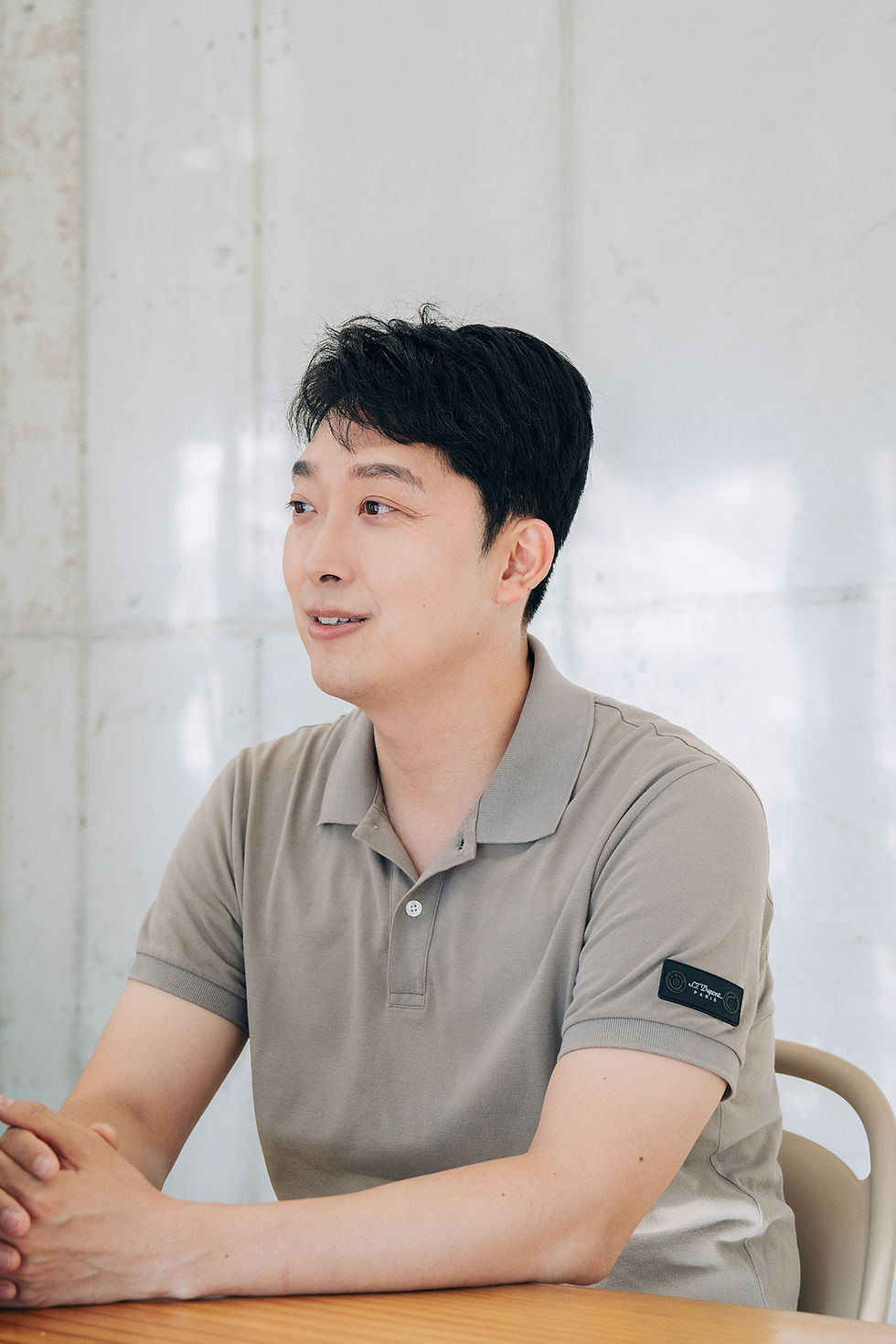
Samjin Fish Cake Park Yong-jun
Samjin Eomuk, understanding and carrying on the essence and value of fish cakes that have nourished the bodies and minds of many people.
Edit Areum Lee
Photograph Yeseul Jun
Fish cakes have been a long-standing, affordable street snack. It was Samjin Eomuk, the oldest fish cake manufacturer in Korea, that brought these treats—once found in the corners of market alleys—into brightly lit stores and commercialized them as gift sets wrapped in packaging. CEO Park Yong-jun states that he will dedicate the rest of his life to understanding and preserving the essence and value of fish cakes, which have nourished the bodies and minds of many people.
It was 1953 when my grandfather opened a fish cake factory under the name 'Samjin Food Processing Plant.' My parents took over the factory, which he had maintained for 30 years, and ran it for another 30 years. It seems you must have special memories of fish cakes from your childhood.
I heard that my grandfather, who learned how to make fish cakes in Japan, rented a shack at the entrance of Bongnae Market and set up a factory. My parents, grandparents, and I lived together in the house inside that factory. Thanks to that, all my childhood memories are related to fish cakes. The house was always filled with a savory aroma, and on weekends, I would wake up to the sound of machinery coming from the factory. Whenever the factory was short-handed, I would be called out to help. Just like doing housework such as laundry or washing dishes, I didn't shy away from any task, from mixing ingredients to packaging and cleaning. I also frequently drove carts or trucks to make deliveries. I continued helping out like that until I went to study abroad in the United States after being discharged from the military.
I am curious about how you came to take over your parents' business.
I majored in accounting at a university in New York. While I was immersed in my studies with the goal of becoming an accountant, I suddenly returned to Korea after hearing that my father's health had deteriorated. It was only after I got home that I realized the company was in a difficult situation. I wrapped up most of my work and returned to the U.S., but I felt restless for over a month. Along with the thought that the factory my parents had built up over the years might disappear without a trace, I felt a sense of duty that I had to continue this work. It was ironic, considering I hadn't thought that studying in the U.S. was something only I could do. That is how I came back to Korea, and I have been involved in company management since 2011.

The fish cake bakery introduced by Samjin Eomuk seems to be one of the catalysts that allowed fish cakes to evolve from a side dish into a snack.
I got the idea from experiences I gained while studying abroad in the U.S. The owner of the house where I stayed ran a bakery, and we used to bake bread together every weekend. Fish cakes and bread have a lot in common in that they both involve kneading ingredients, processing them, and selling them. While thinking about why bread is so much more popular, I recalled the joy one feels in a bakery. Freshly baked bread is always beautifully displayed there, and choosing the bread you want to eat yourself is one of the pleasures of a bakery. I applied this approach to the fish cake bakery as well; we fried and displayed various types of fish cakes in one corner of the store, encouraging customers to fill their trays themselves. This idea was also possible thanks to the know-how my mother accumulated while running a factory for over 30 years. For years, we supplied fish cakes with different shapes and packaging configurations according to the demands of our clients. We were already accustomed to making each unique fish cake product by hand.
What is the most popular menu item at the store?
One product that has been consistently loved is the fish cake croquette. We stuff ingredients inside a fish cake, wrap it up, coat it in breadcrumbs, and deep-fry it; we have a deep affection for it because it seems to have instilled the perception that fish cakes are a special and unique 'food.' The Amazing Bar, a hot dog-shaped fish cake topped with squid, cheese, and other toppings, is also very popular. In fact, not just our popular products, but every attempt we make is an experience and an asset to us. We have witnessed countless instances where projects deemed failures at the time achieved great results through repeated revisions and improvements. My mother played a particularly significant role in product development and product composition.

In what context did the 'Samjin Fish Cake Archiving Project' begin?
As I managed the business, I realized there were almost no records documenting the company's history. Although the things I saw and heard since childhood clearly exist in my memory, I felt a great sense of regret that there were no actual records. I thought that if my generation didn't organize them, they would disappear without a trace. I named this project the "Archiving Project" on my own and began visiting neighborhood elders who remembered when the factory was first established, asking them questions directly, and documenting the process. Since I started in 2012, it has already been over 10 years. The mural inside the fish cake bakery was also painted based on the historical verification provided by the elders. It depicts the process of making fish cakes in the 1950s; I referenced details such as what the ceiling of the fish market looked like back then, the color of the mortar used to make the cakes, and the posture required to push and pull the mortar.
I imagine you have felt a lot while recording over 70 years.
I suppose you could say I was deeply impressed by the craftsmanship of a time when technology was less developed. The ingredients and blending methods were particularly striking. I heard that when my grandfather first opened the fish cake factory, he used a stone mortar to pound and grind the fish. Although productivity is significantly lower compared to today, the value of fish cakes made with a stone mortar is much higher from the perspective of raw materials alone. This is because pounding with a stone results in fish cakes with a better texture and better preserved nutrients compared to mincing with a machine. Since fish is a protein, it is heavily affected by temperature, and stones generate less heat from friction than other tools. As I looked back at these past manufacturing methods one by one, I began to see ways to improve the quality of our fish cakes. Using these records as a foundation, I am currently conducting a renewal project to restore the manufacturing methods from the early days of fish cake production. It is a project that involves a major overhaul of the factory; we aim to establish a system that includes a separate space for artisans specializing in raw material washing and blending, as well as a platform to train young employees.

What did you consider most important when renovating the manufacturing plant?
The core of this renewal project is to provide space and tools so that those who have honed their skills for a long time can pass on their techniques. For example, I found that machines can never replicate the "hand touch" of those skilled in braised or grilled mackerel when seasoning the fish with salt. This is because their ability to judge the condition of the fish and knead it is an area internalized through years of intuition. Internally, we refer to it as "Yeongdo Samjin" because Yeongdo is our starting point and a meaningful place where we have built a 71-year history.

I can feel a deep affection for Busan, as well as Yeongdo.
It is common for companies to relocate their headquarters to Seoul as their business scales expand, often due to issues such as a shortage of manpower or infrastructure. However, Busan and Yeongdo are where I grew up and where Samjin Eomuk began and grew. For this reason, I intend to continue conducting business with Busan as our base. The proximity to the port is also an attractive aspect of our industry. Since last year, I have also served as the president of the Busan Premium Seafood Association. Although I do not like taking on titles, I feel a strong sense of duty to develop Busan's fisheries industry. I believe this is not merely a personal wish, but a change and a demand of the times. It is time for high-quality alternative proteins, particularly seafood proteins that have not received much attention until now, to reach a stage of growth. To this end, I believe we must clearly establish the role of fish cakes as a representative staple food and strive to resolve issues regarding carbon emissions and marine pollution generated during the manufacturing process.

The results of a survey asking local residents about 'Busan's specialties' were interesting. Since 2015, fish cakes have consistently ranked at the top. It seems that fish cakes hold a special significance as a food ingredient in Busan.
It is said that Busan had many Japanese-style izakayas even before the Korean War. As a port city, it was an environment where exposure to various aspects of Japanese culture was inevitable. Fish cakes were one of the signature dishes at these izakayas, but as these menu items came to be regarded as high-end food, more affordable versions began to appear. The fish cake industry in Busan truly flourished during the Korean War. As refugees flocked to Busan and faced food shortages, many people fried minced fish in whale oil, which was relatively easy to obtain, and consumed it. Subsequently, the increase in udon stalls and the use of fish cakes as toppings, among other factors, combined to allow Busan to establish itself as the center of the fish cake industry. Some question whether fish cakes made from fish sourced from overseas can truly be considered a national specialty. However, I believe fish cakes are undeniably a part of Busan's culinary culture. After all, the culture of processing and consuming fish originated right here in Busan about 100 years ago.

As a leading figure in the fish cake manufacturing industry, is there anything you would like to convey to the public?
My grandfather and parents dedicated their entire lives to establishing fish cakes as a traditional Korean street snack. I intend to develop food products in line with the demands and trends of the world, rather than being fixated on immediate profits. I learned from history that achieving something requires a long-term perspective and gradual progress. As a third-generation fish cake maker, I am focusing on understanding and defining the fundamental context of fish cake manufacturing. I believe that once we establish a culture surrounding fish cakes as an affordable protein source and processed seafood, the next generation will be able to accomplish even more meaningful work based on this potential. I consider this to be the essence of a business.

Maker's Pick
Samjin Eomuk's 3 Best-Selling Products

Old-fashioned Assorted Fish Cake Plus
Assorted fish cakes, featuring 12 different varieties with diverse flavors and shapes. The selection is diverse, ranging from vegetable fish cakes packed with fresh vegetables to seafood fish cakes with a rich umami flavor and spicy chili fish cakes. With a generous 1,103g serving size sufficient for the whole family to enjoy, it includes two packets of fish cake soup mix, allowing you to savor the delicious broth as well.

Premium Assorted Fish Cake Soup
All Premium Ilpum fish cake soups are made with fish cakes that are extra chewy and savory, produced through a steaming and frying process. Along with a diverse selection of fish cakes such as seaweed fish cake, sweet pumpkin fish cake, red squid fish cake, square squid fish cake, special leaf-shaped fish cake, squid stick fish cake, white meat ball fish cake, and crab stick hot bar fish cake, fish cake soup sauce and anchovy seafood pack are included, allowing you to enjoy a deeper broth flavor.

Fisherman's bar
Samjin Eomuk's Fisherman's Bar comes in a total of six flavors. These include Corn Cheese, which offers a smoother taste with added corn and cheese; Spicy, featuring an appealing, pungent spiciness; Squid, with a superb texture thanks to the chewy squid; Vegetable, made even more delicious with various vegetables; Whole Shrimp, containing a whole shrimp; and Seaweed, which is savory and light thanks to the addition of domestic seaweed to premium fish cake. It is characterized by being healthy, made with soybean oil, and convenient to eat in a bar form.
Soft and firm
Park Yong-jun
Busan
Edit Areum Lee
Photograph Yeseul Jun

.jpg)
